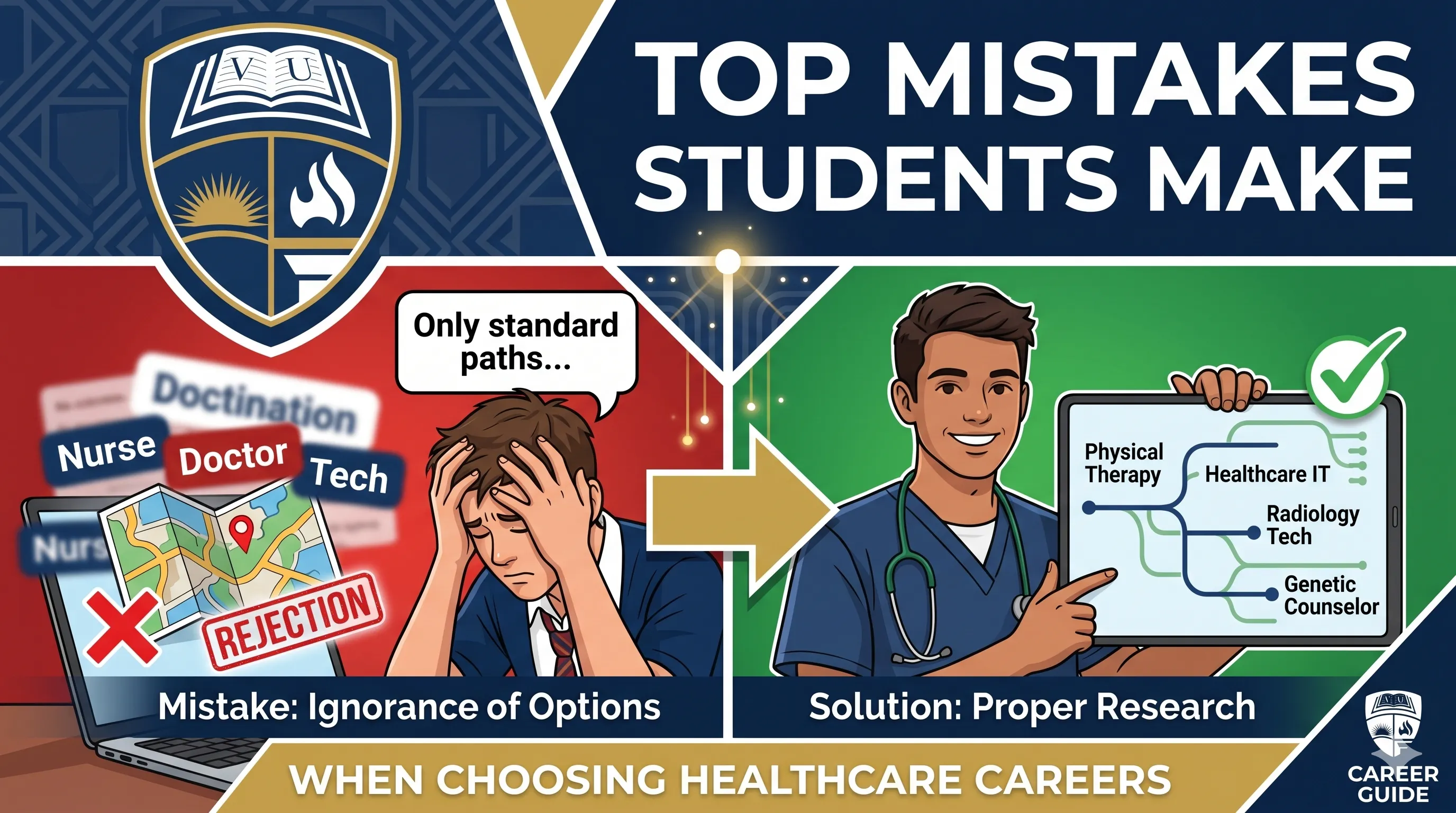
The moment a student clears their 12th board exams, everyone becomes a career expert. The uncle selling insurance has an opinion. The neighbour’s son, who dropped out of engineering, has a “solid plan.” Somewhere in this noise, a young person must pick a path that will shape their next forty years.
Healthcare careers look noble, stable, and respectable, and they are. But they are also brutally unforgiving if chosen for the wrong reasons. Over the years, bright students have repeated the same avoidable mistakes. Some errors are obvious. A few are so subtle that nobody talks about them. Here is what every student needs to know.
Mistake #1: Falling for “Respect” Without Researching Daily Reality
Choosing a healthcare field only to make parents proud is a recipe for quiet burnout. There are pharmacy graduates who never wanted to touch a tablet or understand drug interactions. They picked the field because “doctor ka bhai bhi pharmacist hai” or because it sounded better than a regular B.Com.
Every healthcare role has a gritty underside. For pharmacists, it is not just standing behind a counter. It means memorising hundreds of drug names, understanding contraindications, dealing with stressed patients, and sometimes working night shifts. Before enrolling in any of the Pharmacy Courses in India, a student must ask honestly: Do I actually enjoy chemistry and biology at a microscopic level? If the answer is hesitant, that student is setting up for a long, boring decade.
Mistake #2: Treating All Professional Courses in India as Equal
Many students assume a B.Pharma from a random tier-3 city college is the same as one from an accredited institution. That is false. Professional Courses in India vary wildly in quality, industry connections, and practical exposure.
Take a student named Arjun. He chose a cheap B.Pharma college near his hometown because his father said, “degree toh sabka same hota hai.” Four years later, he could not identify basic drug formulations in an interview. Meanwhile, a friend who invested in solid UG Courses in India with proper lab training got placed immediately. The difference was not intelligence; it was digging deeper than the brochure’s glossy photos.
Mistake #3: Ignoring the Unspoken Specialisations
Most students look at Pharmacy Courses in India and only see the obvious branches, B. Pharma, D.Pharma, maybe M.Pharma later. They completely miss emerging sub-fields that are hiring like crazy: regulatory pharmacy, pharmacovigilance, clinical research, medical writing, and pharmacoeconomics.
Why do students miss them? Because career counsellors and college brochures still live in the year 2005. A student’s job is to look beyond. When evaluating UG Courses in India, they must ask: Does this program offer electives in emerging areas? Is there a placement record for non-traditional roles? If the person on the phone hesitates, that is a red flag.
Mistake #4: Confusing Healthcare with “Only Doctor or Nurse”
So many students with genuine science aptitude abandon healthcare because they think the only respectable options are MBBS or BDS. When their marks don’t make the cut for medical college, they jump into engineering or commerce, fields they never wanted.
If a student enjoys science but not the insane pressure of an ER, exploring Pharmacy Courses in India seriously is smart. That student still saves lives through accurate dispensing, patient counselling, and quality assurance. That is not a “lesser” career. It is a different, equally vital role.
Mistake #5: Believing Pharmacy Means Only a Retail Medical Store
This myth refuses to die. When a student joins Pharmacy Courses in India, a relative will ask, “So you will open a medical shop?” Here is what else a pharmacy graduate can do: work as a drug safety associate, join a pharma company as a quality control officer, become a medical representative, work in pharmacovigilance, get into regulatory affairs, teach after higher studies, or start an online pharmacy brand.
Retail pharmacy is one option, not the only destiny. But a student will never discover these paths without asking the right questions during course selection.
Mistake #6: Making Decisions in Panic Mode
The biggest mistake: waiting until the last week of admissions, then grabbing whatever seat is available. Students have picked Professional Courses in India based purely on which college has not closed admissions yet. That is like buying a house because the real estate agent called first.
Good colleges fill seats months in advance. If a student is serious about pharmacy, they must start research in the 11th standard. Visit campuses. Talk to current students, not just admission counsellors. Ask alumni on LinkedIn about their job search experience.
A Final Thought
A healthcare career has three phases. Phase one: learning textbooks. Phase two: realising real patients and drugs don’t behave like textbooks. Phase three: finding one’s niche, where the person stops feeling like an employee and starts feeling like a problem-solver.
The students who reach phase three are not the ones with the highest marks. They are the ones who chose their path with open eyes, avoided lazy assumptions, and invested time in understanding what UG Courses in India actually deliver versus what they promise on paper.
Want to take the Best choice?
Stop guessing and start building a future that works. Explore accredited, industry-linked Pharmacy Courses in India that makes you well prepared for real-world healthcare challenges, not just exams.
Check out UG Courses in India with Vikrant University that match your strengths. Your career deserves more than a panic decision. Get the facts first.
5 Short FAQs
Q1. Is a B.Pharma program superior to a D.Pharma program for working in hospitals?
Yes, B.Pharma is more suited for clinical exposure, though D.Pharma with internship at the hospital can be considered too.
Q2. Could a pharmacist pursue managerial career?
Certainly. They choose an MBA degree in Pharmaceutical or Hospital management.
Q3. Between pharmacy and engineering, which is tougher?
Pharmacy needs rigorous memorization while engineering involves complex calculations. You have to pick as per your mental ability.
Q4: Do online pharmacy courses have value in India?
For upskilling, yes. For a primary degree, no. Regulatory bodies don’t recognize fully online B.Pharma. Stick to regular UG Courses in India.
Q5: What is a fresh B.Pharma graduate’s starting salary?
₹15,000–₹25,000 in tier-2/3 cities; ₹30,000–₹45,000 in metros with MNCs or clinical research roles. Higher with good internships and communication skills.