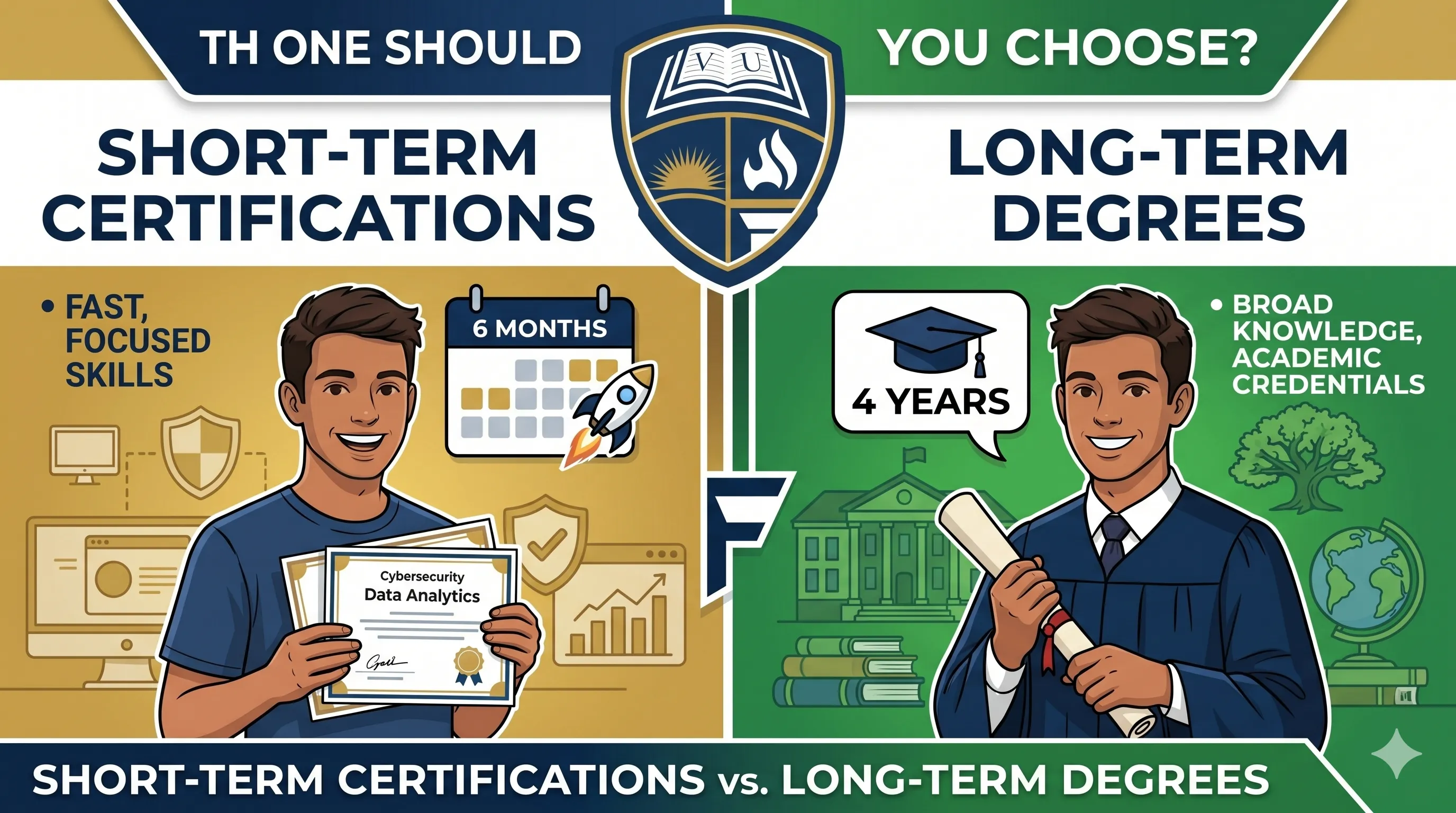
Here is a question that nobody asks out loud but almost every student thinks about:
"Do I actually need a degree for this, or is there a faster way?"
It is quite a common question. Degrees require money and effort; besides, sometimes, they do not match what businesses are looking for. At the same time, the certification looks somewhat superficial and cannot replace professional experience.
Somewhere in the middle, as it usually does. But the path you choose should depend on your specific situation, not on what worked for someone else. Let's break this down honestly.
What a Short-Term Certification Actually Gives You
A certification programme is built around one thing: a specific, teachable skill. You enrol, you learn that skill, you get assessed, and you leave with a credential that says you can do the thing.
- Short-term certifications PG Courses in India work exceptionally well in fields that move quickly, such as digital marketing, cybersecurity, cloud computing, graphic design, video editing, and data analytics.
- These are areas where the technology evolves so rapidly that a degree earned four years ago might already feel outdated.
- What matters more is current skill, and certifications are good at delivering that.
They're also significantly cheaper. For a student who has just finished school and is working with a tight budget, the cost difference between a six-month certification and a four-year degree is not trivial.
What a Long-Term Degree Actually Gives You
A degree does something a certification fundamentally cannot: it builds depth.
When you spend three to four years in a structured academic programme, you're not just learning skills.
- You're developing a way of thinking, analytical frameworks, problem-solving approaches, and the ability to handle complexity.
- You're also building a professional network through batchmates, faculty, and campus placements.
- You're earning a credential that carries institutional weight, something that still matters in a lot of industries.
For certain career paths, a degree isn't optional. Law, medicine, engineering, architecture, and teaching have legal or professional requirements that no certification can substitute for. If your goals fall anywhere in that zone, the decision is already made for you.
The Real Question: What Are You Trying to Achieve?
This is where most students get stuck. They spend so much time comparing certification versus degree as abstract categories that they forget to apply the question to their own life.
Here are the situations where each path tends to make more sense:
Choose a short-term certification if:
- You already have a degree and are upskilling in a specific direction
- You want to enter a skill-based field quickly and build from there
- You're exploring a career change and want to test the waters before committing
- Budget or time constraints make a full degree impractical right now
Choose a degree if:
- You're entering a regulated profession that legally requires one
- You want the foundational depth that comes with structured, multi-year learning
- Long-term career growth in corporate or government roles is your priority
- You're fresh out of school and haven't yet identified a highly specific career direction
Professional Courses After 12th sit in an interesting middle ground. Diploma programmes, which are typically one to three years, offer structure and depth without the full commitment of a four-year undergraduate degree.
The Diploma Option: Where Both Worlds Meet
If the choice between a two-week certification and a four-year degree feels like an either/or trap, diploma programmes are the exit door.
Professional Courses in India at the diploma level are designed exactly for this in-between space. They combine practical, skill-focused training with enough academic rigour to make the credential credible. They provide a wide variety of fields, which include engineering, healthcare, business, design, IT, and more.
What About Postgraduate Options?
Here's an angle most students overlook when they're fresh out of school: the long game.
If you're planning to pursue higher education eventually, a master's degree or a specialised postgraduate qualification, the foundational choice you make now matters enormously. PG Courses in India are designed for candidates who already have a bachelor's or equivalent qualification. The quality of your undergraduate preparation directly affects your options at the postgraduate level.
This means that choosing a short-term certification as your only qualification might close certain doors down the line. But a diploma or degree, even in a slightly different field, keeps your academic trajectory open.
If long-term career depth and eventual specialisation are on your radar, structure your early education accordingly.
Choosing Wisely
Before you decide anything, be honest with yourself about three things: where you want to be in five years, how much time and money you can realistically invest right now, and whether your target industry cares more about credentials, skills, or both.
Professional Courses in India today come in enough shapes and sizes that there's almost certainly a structured option that matches your answer to all three. You don't have to pick between fast and good. Sometimes the right programme gives you both. Browse diploma and professional programmes at Vikrant University, structured, career-focused, and built for where India's workforce is heading.
Frequently Asked Questions
Q1. Are Professional Courses After 12th a good alternative to a traditional degree?
Yes, for many students, they are. Diploma and certificate programmes after 12th offer structured, career-focused learning in a shorter timeframe.
Q2. What is the view of Indian employers towards short-term certifications versus degrees?
It depends on the sector. For the IT, design, and digital sectors, certifications by reputed organisations hold a lot of value and may even be more valued than a general degree.
Q3. What are PG courses in India, and what are they suitable for?
PG Courses in India refer to postgraduate courses that are suitable for students who have graduated at the undergraduate level.
Q4. Can I switch from a certification to a degree programme later?
In most cases, yes. If you complete a recognised diploma, many universities allow lateral entry into the second year of a relevant undergraduate programme.
Q5. How do I decide between a short-term certification and a diploma programme?
Consider the depth of knowledge your career requires. If you need to learn one specific skill quickly, a certification may be enough.