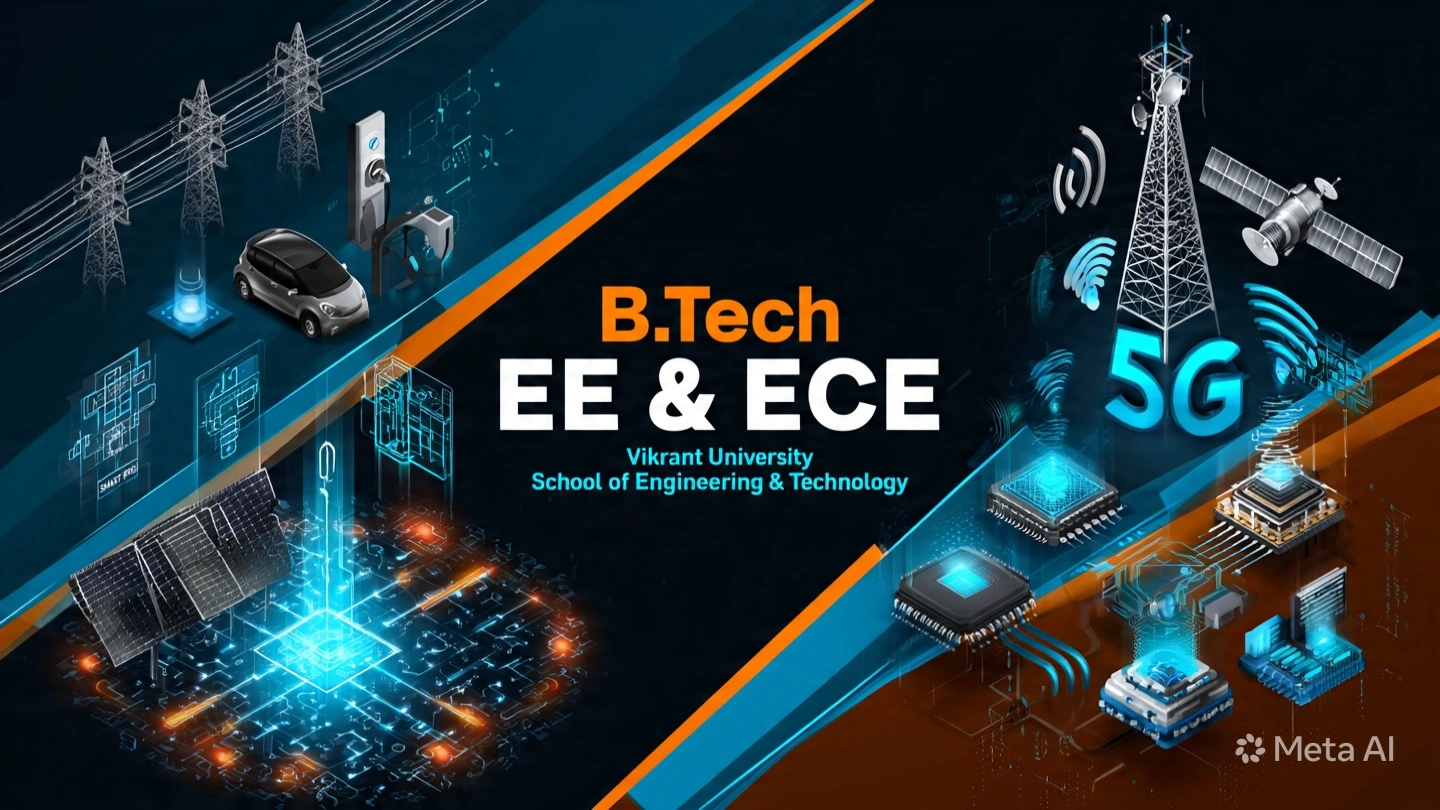
Think about a time when you couldn't use electricity, talk on a cell phone, surf the Internet, or get around in today's transportation systems. All these things depend on systems that engineers have built and people use every day of their lives. Whether it is providing electrical energy to homes, supporting different manufacturing companies, connecting people all over the world, or developing things such as electric vehicles (EVs) or smart electrical power grids, these two degrees will help advancements in today's tech-focused society.
There are huge opportunities available for people who have studied different forms of electronic engineering and have a passion for technology, innovation, problem solving, and applying science in real life. Engineers with this education will be needed more than ever as companies shift toward the use of modern technologies to gain a competitive edge and as they pursue environmentally responsible products and services.
At Vikrant University School of Engineering & Technology we offer B.Tech in Electrical Engineering (EE) and B.Tech in Electronics & Communication Engineering (ECE), that prepare individuals for a career in an ever-changing world through the acquisition of technical knowledge, practical skills, and industry-relevant experience. The curriculum is designed to include experiential learning, innovation and career-oriented training in order to develop tomorrow's leaders within these fields.
Program at a Glance
|
Particulars |
Details |
|
Programs |
B.Tech Electrical Engineering (EE) & B.Tech Electronics & Communication Engineering (ECE) |
|
School |
School of Engineering & Technology |
|
Duration |
4 Years |
|
Eligibility |
10+2 examination in relevant subjects from a recognized board |
|
Lateral Entry |
3-Year Polytechnic Diploma from a recognized board (As per AICTE Norms) |
|
Learning Approach |
Academic Excellence, Practical Learning, Industry Exposure and Innovation |
Why These Engineering Disciplines Matter More Than Ever
Due to the current pace of advancements in energy systems, telecommunications, automation, electronics, & digital infrastructures, industries are looking to hire engineers who will help them develop smarter, safer, and more sustainable technology.
Thus, students often want to know the following:
- Best engineering branch after 12th
- Scope of Electrical Engineering
- Electronics and Communication Engineering career opportunities
- Electrical Engineering jobs
- Future scope of ECE
- B.Tech Electrical Engineering
- B.Tech Electronics and Communication Engineering
- Career opportunities in core engineering
- Electric Vehicle engineering
- Renewable Energy careers
The Electrical Engineering and Electronics & Communication Engineering will provide a strong base to work in many different fields related to the technological evolution taking place around the world and the changes we see being made in our daily lives as new products are created and introduced.
Understanding Electrical Engineering
Electrical engineering is the generation, transmission and overall use of electrical energy in such a way as to maximize efficiencies. This ancient branch of engineering contributes substantially to the generation of power for homes, businesses, public transport systems, and general city infrastructure
The B.Tech Electrical Engineering at Vikrant University is an innovative educational program that prepares a new generation of energy professionals. With an emphasis on concepts relating to energy production and use, and with increased focus on new and emerging topics such as -
Renewable energy technologies
Smart grid systems
Electric vehicle technology
Industrial automation
Power electronics
Energy management systems
High-voltage engineering
The B.Tech EE program aligns with current needs of industry around energy production and power, and prepares students to be active contributors in both of these growing sectors of the economy.
Understanding Electronics & Communication Engineering
Electronics and Communication Engineering is the specific field in which we can create and develop technologies to allow the world to connect as one. Each interconnection such as cellphone calls, internet connections, and satellite transmissions, are accounted for by discovery and further implementation of both electronics and communication based technologies.
The focus of this ECE degree program is in developing competencies in the following areas:
- Electronic circuits and devices
- Communication systems
- Signal processing
- Embedded systems
- VLSI design
- Wireless communication
- Robotics and automation
- Digital electronics
Students will gain knowledge on how information is processed, converted to print, transmitted and secured, using communication technology. With every industry being impacted by connectivity and therefore requiring electronic engineers to be continually developing innovative products and create technological improvements to systems already in use.
Learning Through Practical Experience
Engineering is not just about understanding theories but it is about applying them to solve real-world problems.
The School of Engineering & Technology at Vikrant University follows a hands-on approach that encourages students to learn through experimentation, projects, innovation, and practical applications. The institution promotes an exploration, innovation, and collaboration-driven learning environment that helps students bridge the gap between classroom learning and industry expectations.
Students are encouraged to participate in:
- Laboratory-based learning
- Technical workshops
- Engineering projects
- Industry-oriented training
- Innovation activities
- Research initiatives
- Practical assignments
This approach helps students develop both technical expertise and professional confidence.
Modern Infrastructure and Engineering Laboratories
A strong engineering education requires access to quality infrastructure and advanced laboratories.
The School of Engineering & Technology provides facilities that support practical learning and technical skill development, including:
Electrical Machines Laboratory
Students gain practical exposure to transformers, motors, generators, and electrical equipment.
Power Electronics Laboratory
Hands-on learning with converters, inverters, thyristors, and power control systems used in modern industries and electric vehicles.
Control Systems Laboratory
Students learn automation, system stability, and industrial control techniques.
High Voltage Engineering Laboratory
Understanding insulation systems, electrical safety, and power engineering concepts.
Electronics and Communication Laboratories
Practical learning in circuit design, embedded systems, communication technologies, and digital electronics applications.
Smart Classrooms and Central Library
The university provides a modern learning environment with digital classrooms, technical resources, and academic support facilities.
Career Opportunities in Electrical Engineering
Graduates can explore roles such as:
- Electrical Design Engineer
- Power System Engineer
- Renewable Energy Engineer
- EV Systems Engineer
- Electrical Maintenance Engineer
- Automation Engineer
- Control and Instrumentation Engineer
- Energy Analyst
Career Opportunities in Electronics & Communication Engineering
Graduates can pursue careers as:
- Electronics Engineer
- Communication Engineer
- Embedded Systems Engineer
- VLSI Design Engineer
- Telecommunications Engineer
- Network Engineer
- Robotics Engineer
- Signal Processing Engineer
ECE and EE Engineering graduates have Opportunities Beyond the Core Engineering Careers. Both Electrical and PEC graduates have multiple career paths available to them outside of engineering through Information Technology, Software Development, Data Analytics, Technical Consulting, Research & Development, Government Organizations & PSUs.
Future Scope of Electrical Engineering and Electronics & Communication Engineering
Below is a list of fast-growing areas of Electrical Engineering:
- Renewable Energy
- Smart Cities
- Electric Vehicles
- Smart Grids
- Sustainable Infrastructure
- Industrial Automation
Below is a List of fast-growing areas of Electronics and Communication Engineering:
- 5G and Future Communication Networks
- Internet of Things (IoT)
- Artificial Intelligence Integration
- Embedded Systems
- Robotics
- Semiconductor Technology
- Advanced Communication Systems
With the continued investment by Industry in terms of innovation and digital transformation, Engineers with knowledge and skills in these domains will continue to be very much in demand.
What Makes Vikrant University a Great Choice for Electrical Engineering and Electronics and Communication Engineering Programs?
The institution a student chooses to study engineering at is one of the major milestones in their academic career path. The School of Engineering and Technology at Vikrant University strives to produce quality engineers that will be ready for employment in today's workforce. They provide their students with:
-
- An Industry-Oriented Curriculum
- Hands-On and Experiential Learning
- Fully Equipped Engineering Labs
- Smart Classroom with Digital Learning Environments
- Persistent Mentoring from Professors with Industry Experience
- Opportunities to Participate in Research and Innovations
- Training and Placement Support
- Access to New Technologies
- A Student-Centric Learning Environment
Vikrant University's mission is to prepare them to be Engineers by providing an Engineering Education that is "on par" with" Global Standards" while at the same time developing Engineers and/or Professions that are capable of making a positive contribution to their communities/industry..
Frequently Asked Questions (FAQs)
Which is better: Electrical Engineering or Electronics & Communication Engineering?
Both of these fields are viewed as having outstanding future career prospects. Electrical engineering is generally considered to offer opportunities related to power systems, energy generation, electric vehicles, and automation of various types, while electronics & communication engineering will typically provide opportunities associated with electronics and communication technologies, embedded systems and digital connectivity.
What is the duration of these programs?
Both degree programs are four (4) years in duration and will lead to a UG degree in engineering discipline.
Is lateral entry available?
Yes. Students with a recognised 3 year Polytechnic Diploma may be able to apply for admission through lateral entry into Electrical or Electronics & Communications Engineering degree programs according to AICTE guidelines.
Is Electrical Engineering a good career option in the future?
Yes. The demand for electrical engineers will increase due to the increased use of renewable energy, electric vehicles, smart grids and automation within the industrial sector.
What is the scope of Electronics & Communication Engineering?
ECE graduates have opportunities in telecommunications, embedded systems, electronic design, networking, VLSI, robotics, and emerging communication technologies.
Can graduates work in the IT sector?
Yes. Many graduate Electrical Engineers and ECE majors are successfully finding career opportunities in the field of software development, data analysis, consulting, and many other technology-based industries because of their strong skills in both analytical and problem-solving.
Conclusion
Engineering has been responsible for many advances in technology that enhance our quality of living. This includes the development of many products we rely on every day including: clean energy sources, electric vehicles, smart phones, automation systems and smart devices. B.Tech in Electrical Engineering and Electronics & Communication Engineering are both academic degrees but they're also pathways to finding solutions to some of the biggest challenges we face today, as well as creating technologies of the future.
At the School of Engineering and Technology at Vikrant University, we provide students with the knowledge, hands on experience, technical skills and industry context necessary for success in these rapidly changing areas. With strong academic foundations; state-of-the-art facilities; and Education that is aligned with future demands, we develop engineers who can help create innovation, promote sustainability and improve technology.
If you're interested in pursuing a rewarding career in Electrical Engineering, Electronics & Communication Engineering, Renewable Energy, Electric Vehicles, Industrial Automation, Telecommunications or Embedded Technology; then come join us at Vikrant University and let us help you Learn, Innovate and Grow.