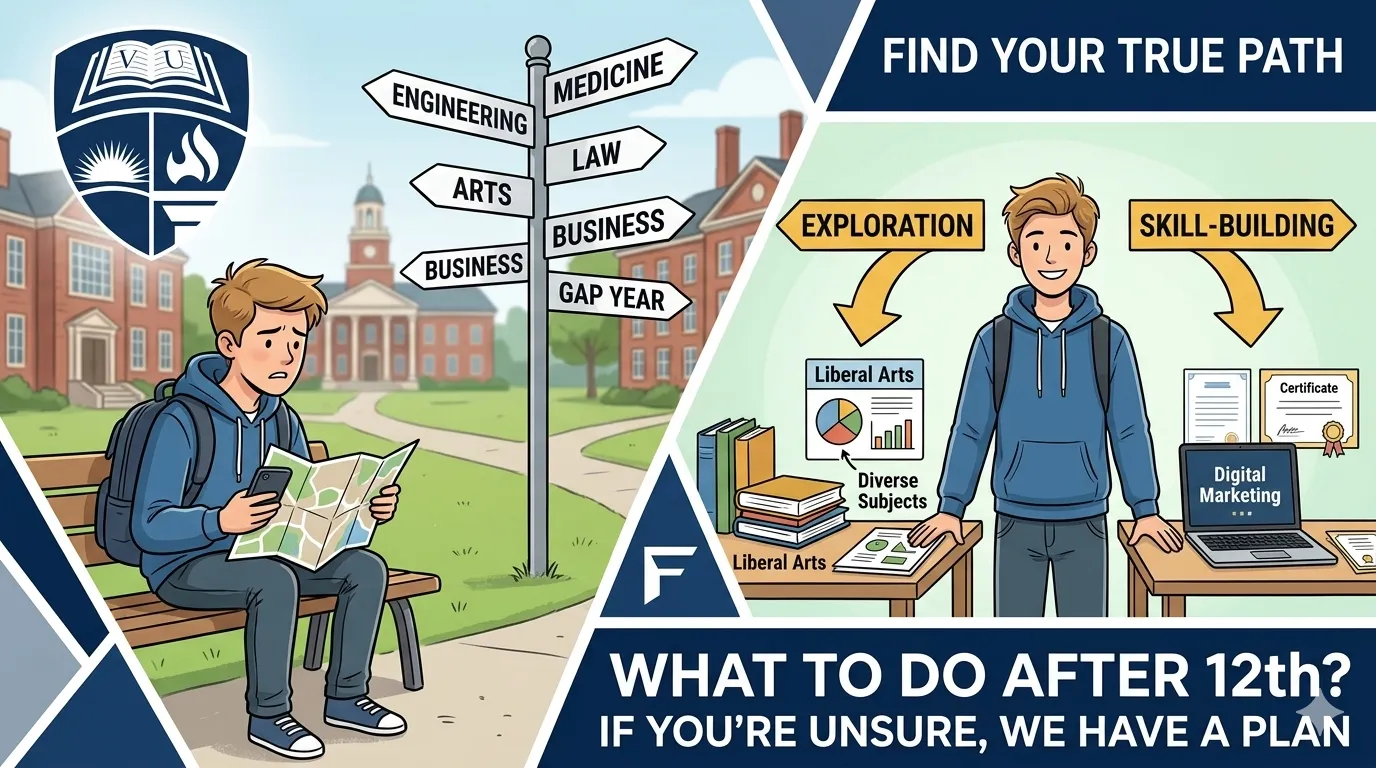
Nobody tells you this, but the weeks right after your 12th board exams are one of the strangest phases of a young person's life. You've spent years studying for a finish line, and the moment you cross it, you're expected to immediately know exactly what you want to do with the next forty years of your life.
Most students don't know what they want at 17 or 18. That's not a failure of ambition. It's just reality. The pressure to pick a stream, choose a college, and commit to a career path before you've even had a chance to breathe can push students into decisions they later regret, or worse, into paralysis where they make no decision at all.
Here's the thing, you need to know about professional Courses After 12th. What matters is that you take a step. Even a small, exploratory one. Because the students who figure out their direction fastest aren't the ones who had everything mapped out from day one.
First, Separate the Noise from What Actually Matters to You
Before you look at any course or program, spend a little time asking yourself some honest questions.
- Not "what pays well" or "what do my parents want", those are external filters. Start internal.
- What subjects held your attention, even a little? What kind of problems do you find yourself thinking about? Are you drawn toward building things, helping people, solving puzzles, managing situations, or creating something?
- These aren't just personality quiz questions; they're real signals about where your energy naturally flows, and that's worth paying attention to when choosing a course.
The biggest mistake students make is choosing a program based solely on reputation or peer pressure. A prestigious course that doesn't match your aptitude will drain you.
What are the Some Professional Courses After 12th?
One of the most underrated paths available to students today is enrolling in structured professional courses after 12th, programs specifically designed to build job-ready skills in a defined period of time, without requiring years of broad academic study before you ever touch anything practical.
- These courses exist across nearly every field: technology, healthcare, business, design, law, agriculture, engineering, and more. They are built around industry requirements, which means what you learn in class has a direct relationship to what employers actually need.
- The diploma and undergraduate programs are designed with exactly this philosophy. Whether a student wants to enter the IT workforce, explore pharmaceutical sciences, build a career in management, or understand legal systems, there are structured pathways waiting.
The Vikrant University offers over 40 diploma programs and 60+ undergraduate programs across the schools of engineering, management, pharmacy, law, agriculture, computer applications, arts, and more.
Diploma vs. Degree: Which Route Makes Sense?
This is one of the most common questions undecided students ask, and there's no single right answer, but here's a useful way to think about it.
Diploma programme
- If you want to enter the workforce relatively quickly, develop hands-on technical skills, and start building professional experience sooner, a diploma programme is a strong path.
- Most diploma courses run for one to three years, focus heavily on practical training, and prepare students for specific technical roles in industries like construction, electrical work, information technology, pharmacy, and business operations.
UG degree
- If you would like to acquire more knowledge, have more time to figure out what field suits you best, and earn a qualification that can help you enroll in further studies or enter the workforce, then you should go for a UG degree.
- UG courses in India span three to four years and cover a wide range of disciplines. They also allow for future progression into postgraduate studies, research, or specialized professional paths.
Both routes are legitimate. The right one depends on your timeline, your financial situation, your interest in a specific field, and how clear (or unclear) you feel about your long-term direction.
What If You're Still Genuinely Unsure?
Here's a practical approach that works for students who truly can't decide yet: choose a path that keeps options open rather than closes them.
- A BCA (Bachelor of Computer Applications) gives you strong IT foundations that translate across dozens of industries.
- A BBA opens up careers in management, entrepreneurship, and business while also providing a strong foundation for an MBA later.
- A BSc in a science discipline keeps research, medicine, and applied science careers accessible.
Among the professional courses in India, these are the ones that are genuinely versatile; they don't lock you into a narrow box, they give you skills that apply in multiple directions.
Not Sure What’s Next? Start Here
Are you still figuring things out? That's completely okay. Explore the full range of professional courses after 12th at Vikrant University, and take the first step toward a future you'll actually look forward to. Apply now or speak with an admission counselor today."
FAQs (Frequently Asked Questions)
Q1. Can I change my stream after 12th while choosing a professional course? Yes, various subjects such as BBA, BCA, along with some diploma programs, admit candidates from any background: Science, Commerce, and Arts.
Q2. Are diploma courses after 12th worth it, or should I go for a degree?
Both are equally valuable. A diploma makes you enter the world of work faster due to the development of practical abilities. A degree will give more knowledge as well as better prospects for further learning. It is up to you and your plans.
Q3. Which professional courses after 12th have the best job placement?
Computer Applications, Engineering Technology, Pharmacy, Management and Law are some subjects that have high placement activities. Institutions like Vikrant University provide placement assistance in all important courses.
Q4. What if I want to pursue higher education after a diploma?
Many people prefer to go in for lateral entry into B.Tech or other degree courses after gaining a diploma. Diploma does not mean that one cannot opt for a degree course.
Q5. How do I choose the right UG courses in India if I have no clear direction?
Start with your interests rather than market trends. Speak with academic counsellors, look at what the first two semesters of a course cover, and choose something that genuinely feels engaging.