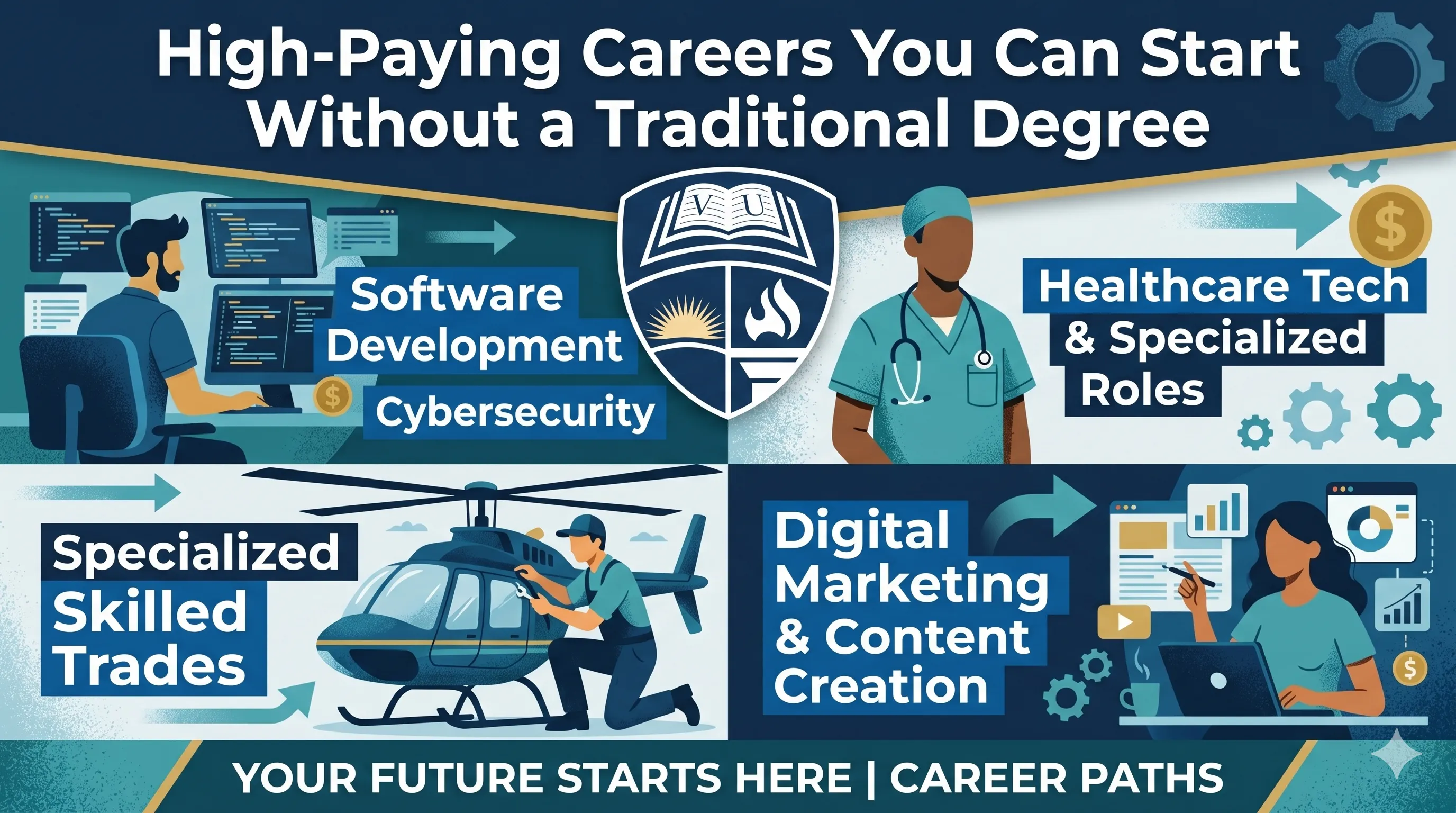
There's a quiet shift happening in India's job market, and most people haven't noticed it yet.
Employers are slowly loosening their grip on the degree filter. What they want now is skill, proof, and adaptability. Not a piece of paper that took four years and a small fortune. This doesn't mean education doesn't matter; it very much does. But the definition of education is expanding.
If you've ever felt boxed out by the "Bachelor's degree required" line on a job posting, this piece is for you.
Why the Degree Barrier Is Cracking
The traditional argument was simple: a degree signals discipline, intelligence, and the ability to complete long-term commitments. Fair enough. But the same argument now applies to someone who has completed rigorous Professional Courses in India, earned industry certifications, and built an actual portfolio of work.
Companies like Google, IBM, Apple, and, closer to home, many Indian tech firms and startups, have publicly announced they no longer require four-year degrees for several roles. What changed? The skills gap got too wide. There simply weren't enough qualified degree holders to fill positions in cybersecurity, UX design, data analytics, and digital marketing. The talent market adapted. So should you.
6 High-Paying Careers That Don't Need a Traditional Degree
1. Web Developer / Full-Stack Developer
Average salary range in India: ₹4–18 LPA (depending on skills and experience)
Coding is still one of the most reliable skill-to-income conversions available today. You don't need a computer science degree to become a developer; you need to actually know how to build things. Frontend, backend, or full-stack, the proof is your GitHub repository and the apps you've shipped.
Diploma-level and certificate programmes in web development can get you job-ready in under a year.
2. Digital Marketing Specialist
Average salary range: ₹3–12 LPA
Every business, from a local clothing brand to a global SaaS company, needs someone who understands SEO, paid advertising, social media strategy, and content marketing. This is a field where certifications and demonstrated results carry far more weight than a marketing degree.
A well-structured diploma programme can teach you Google Ads, Meta campaigns, analytics, and email automation, the practical toolkit that employers actually want.
3. Graphic Designer / UI-UX Designer
Average salary range: ₹3.5–15 LPA
If you can build a portfolio that shows you understand visual communication and user psychology, you're already ahead of most applicants. Design is one of the most portfolio-driven fields in existence. No hiring manager is going to ignore a stunning case study because you have a diploma instead of a degree.
Professional Courses After 12th in graphic design or UI/UX can lay an exceptionally strong foundation, especially when paired with personal projects and freelance work.
4. Pharmaceutical / Medical Lab Technician
Average salary range: ₹2.5–7 LPA (with significant growth over time)
This is a profession which requires more specialisation and on-the-job training than anything else. Students from the field of paramedical diploma courses, such as medical imaging, lab technician, or physiotherapy assistants, find their work opportunities at hospitals, clinics, and diagnostic centres.
This is probably the best example of how UG Courses in India are giving rise to career options that truly make a difference.
5. Data Analyst
Average salary range: ₹4.5–16 LPA
Data literacy is the new financial literacy. Companies are drowning in numbers they can't interpret. A skilled data analyst who knows Python, SQL, and data visualisation tools is worth their weight in gold, degree or not.
Online and in-person diploma programmes now offer structured paths into data analytics that go far beyond YouTube tutorials. You learn the thinking, not just the tools.
6. Video Editor / Content Creator
Average salary range: ₹3–10 LPA (much higher for independent creators)
The content economy is real, and it's enormous. OTT platforms, YouTube channels, corporate marketing teams, ad agencies, everyone needs skilled editors. If you're good with Adobe Premiere and DaVinci Resolve and you understand storytelling rhythm, you're employable.
Short-form content creation, in particular, is a skill that barely existed five years ago and now commands serious salaries.
A Word on Long-Term Growth
Starting without a traditional degree doesn't mean staying without one. Many professionals in India begin with a diploma or certificate, get work experience, and pursue UG Courses in India through part-time or distance learning. This path, earn, then learn more, is increasingly respected because it combines real-world context with academic depth.
The goal was never to skip education. It was always to make smarter choices about which education to pursue and when.
Are you ready to explore your options? Browse diploma and degree programmes at Vikrant University and find a path that aligns with where you want to go.
Frequently Asked Questions
Q1. Can I really get a high-paying job in India without a traditional degree?
Yes, many of the companies hire individuals directly from expertise in different fields, which includes technology, design, digital marketing, health-care assistance, and many more.
Q2. What are the best Professional Courses in India for students after 12th? Diploma courses in different streams, like web designing, graphics designing, digital marketing, paramedical science, data analytics, and so on, can be regarded as some of the best professional courses in India.
Q3. What is the duration of diploma/professional courses?
The time frame of most of the diploma courses varies between 1 year and 3 years, according to the stream. There are also some short-term certification courses available, ranging from 6 months to 12 months.
Q4. Does an employer in India recognise diplomas?
Yes, because all diplomas granted from recognised/accredited colleges or universities are widely acknowledged by Indian employers. The addition of a portfolio, together with an internship, further enhances your job opportunities.
Q5. Can one pursue a full degree after obtaining a diploma?
Yes, one can easily enrol himself/herself for a lateral entry programme in universities where diploma holders get admission right from the second year of their respective degrees.