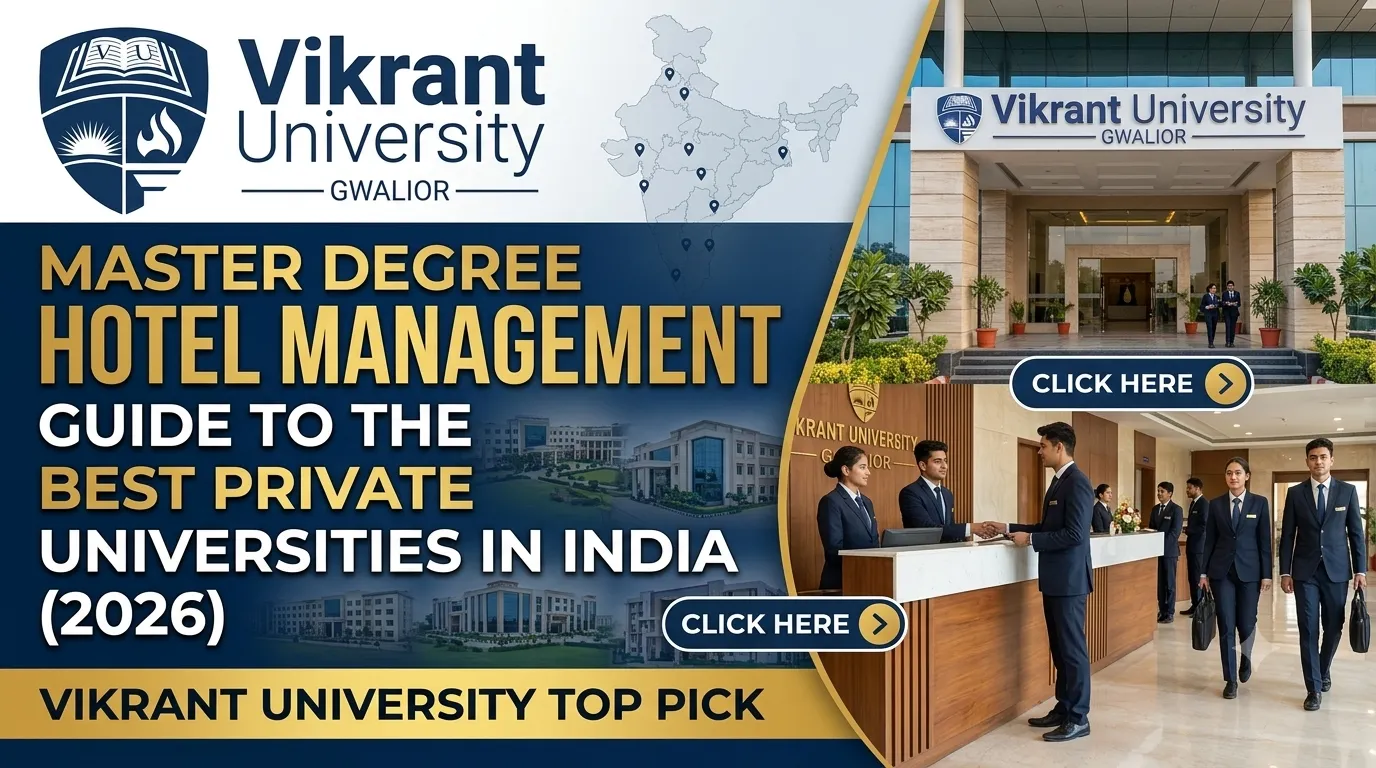
Choosing the right postgraduate program is one of the most critical decisions you will ever generate. The global hospitality sector is no longer just about service; it has evolved into a complex, multi-billion-dollar industry driven by data analytics, luxury branding, and operational excellence. If you are a graduate student, a working professional, or a concerned parent researching a stable, high-growth career, a Master Degree Hotel Management is not just a degree— it is a passport to a borderless career.
In India, the landscape of private higher education has transformed dramatically. With the implementation of NEP 2020, the best private universities in India are now bridging the gap between theoretical academic frameworks and the dynamic operational demands of the industry. This guide is meticulously designed to answer every question you have about pursuing a master’s in hotel management in India— from syllabus specifics and eligibility to fees and career outcomes— while introducing you to a rising star in central India: Vikrant University, Gwalior.
We will cut through the noise, stick to verified facts, and contribute you produce a decision that aligns with your career aspirations and financial planning.
What is a Master Degree in Hotel Management?
Before diving into university comparisons, let’s clarify the nomenclature a Master Degree Hotel Management is an advanced postgraduate program that trains students for leadership roles. Unlike an undergraduate degree, which focuses on operational skills, a master’s program hones strategic decision- making, asset management, and revenue optimization.
When you search this field, you will encounter three primary academic paths. Understanding the distinction is crucial for your career trajectory:
MHM Course in India (Master of Hotel Management): This is a traditional, specialized course focusing deeply on the core operational areas of hospitality, including accommodation management, advanced food production, and property management systems.
MBA in Hotel Management: An industry-specific MBA blends core business administration subjects (Finance, Marketing, and HR) with hospitality verticals. This is ideal for those aiming for corporate roles in hotel chains, consulting, or entrepreneurship.
MSc Hotel Management (Master of Science): This program often has a stronger focus on the scientific and technical aspects, such as culinary science, nutrition, housekeeping technology, and hospitality research methodology.
Key Takeaway
|
Program |
Primary Focus |
Ideal Candidate |
|
MHM |
Core Hotel Operations & Administration |
Departmental Heads, Operations GMs |
|
MBA in HM |
Business Strategy, Finance, and Marketing |
Corporate leadership, Revenue Managers, Consultants |
|
MSc HM |
Technical, Scientific & Academic Research |
R&D Specialists, Academicians, Technical Experts |
Why Pursue a Hospitality Management Master’s Degree Now?
The" golden era" of hospitality is being redefined. According to recent industry analyses, the demand for trained management professionals exceeds supply by a significant margin, particularly in the luxury and experiential travel segments. Here is why investing in a hospitality management master's degree in 2026 is a strategic move:
The Experience Economy: Modern consumers allocate more on experiences than goods. This shift demands managers who understand "experience design," not just hotel administration.
Tech- Hospitality Convergence: Hotels are now tech hubs. Artificial Intelligence in revenue management and blockchain in secure payments are not future concepts; they are current operational realities requiring tech- savvy managers.
Career Acceleration: A bachelor’s degree gets you an entry-level supervisory role. A postgraduate hotel management course propels you directly into Management Trainee or Assistant Manager Positions, effectively bypassing years of grunt work.
Eligibility for Master's in Hotel Management: Are You Qualified?
One of the most common questions from parents and students revolves around the entry barriers. The eligibility for Master's in Hotel Management is relatively standardized across UGC-approved private universities but comes with specific academic prerequisites.
Standard Requirement: A Bachelor’s degree in Hotel Management (BHM/ BSc in Hospitality) from a recognized university. A minimum aggregate score, usually 50%, is a standard cutoff.
Cross- Discipline Eligibility: This is a critical point of differentiation for Vikrant University. Many prestigious universities now accept graduates from Commerce, Arts, or Science streams, provided they have a genuine interest in the service sector. This opens doors for career switchers.
Entrance Exams: While some autonomous universities rely on their own aptitude tests, most private universities in India now accept national-level scores esteem CUET- PG or rely on direct merit- based interviews, assessing communication skills and personality traits crucial for hospitality industry management careers.
Expert Insight: If your undergraduate degree is in a non-hospitality field, strengthen your application with short-term certifications in food safety or front office operations and a stellar statement of purpose explaining your passion for the industry.
Decoding the Hotel Management Postgraduate Syllabus
A master’s program is only as effective as its syllabus. Gone are the days of rote learning. The modern hotel management postgraduate syllabus in India is built on a modular, outcome-based education model.
Year 1: Foundation & Tactical Management
Advanced Food & Beverage Management: Strategic cost control, menu engineering, and supply chain logistics.
Rooms Division Analytics: Advanced yield management, dynamic pricing strategies, and property management software.
Human Capital Strategy: Talent acquisition, training ROI, and labor law compliance.
Hospitality Marketing& Branding: Digital reputation management, CRM, and experiential brand building.
Year 2: Strategy, Research & Application Financial
Management & Revenue Optimization: Feasibility studies, asset valuation, and profit-center accounting.
International Hospitality Law: Cross- border regulations, franchise agreements, and contract law.
Entrepreneurship & Business Plan Development: Incubating a restaurant or boutique resort concept.
Capstone Project/ Internship: A 4-6 month intensive industry training where theoretical knowledge is tested against real- world chaos.
Hotel Management Fees for Master’s Degree: An Investment Perspective
Understanding the hotel management fees for master's degree programs is essential for financial planning. The cost varies based on infrastructure and brand affiliation. However, expensive doesn't always mean better.
Private universities in India generally operate in a tuition bracket of INR 1.5 lakhs to 4 lakhs per annum for the program. The true value lies in the" hidden costs" of education— uniforms, toolkit equipment, industrial visits, and international exposure tours. A transparent fee structure, value the one advocated at Vikrant University, ensures no hidden charges, making it easier for parent’s budget for the entire hotel management course duration.
Before you finalize an institution, inquire about scholarships. The Vikrant University Scholarship Program offers financial assistance based on merit and need, making quality private education accessible.
The Admission Process: How to Secure Your Seat
The hotel management master's admission process in top-tier private universities is straightforward but competitive. It is designed to filter for attitude, not just aptitude.
Application Submission: Visit the official Vikrant University Admissions Portal and fill out the online form.
Document Verification: Submit your bachelor’s degree marksheets, 10+ 2 certificates, and a valid ID proof.
Admission Interaction: Shortlisted candidates are invited for a personal interaction. Here, the panel assesses your communication clarity, problem- solving abilities, and cultural fit.
Merit Listing & Offer: Selection is made based on the composite score of your undergraduate performance and the personal interaction. There’s no unnecessary entrance exam stress.
Confirmation: Pay the admission fee to block your seat in one of the most promising postgraduate hotel management courses in the region.
Career Opportunities: Where Will You Work?
Let’s articulate about the return on investment. The career opportunities after Master's in Hotel Management are incredibly diverse. This degree does not limit you to a hotel lobby.
Employment Sectors
Core Hotels & Resorts: From Operations Manager to General Manager.
Luxury Retail: Managing high-net-worth client experiences.
Airlines & Cruise Lines: In-flight services management and cruise director roles.
Healthcare & Facility Management: Hospitality in hospitals is a booming sector focusing on patient experience.
Consulting: Revenue management and feasibility consulting.
Salary after Master's in Hotel Management
The salary after Master's in Hotel Management is a common query, and while it varies by brand and city, the data is promising. A management trainee can expect to start between INR 5 to 8 LPA. However, with specializations in revenue or finance, salaries rapidly scale into seven figures within a decade.
Vikrant University’s robust placement network ensures that students are not just applying blindly but are headhunted. The focus on hospitality management placements after post graduation ensures alumni are working with Marriott, ITC, Taj, Oberoi, and international cruise liners.
Skills Required: The Vikrant University Edge
It’s not enough to know the theory; you must be a "hospitality athlete." The skills required for hotel management professionals are both soft and hard.
|
Core Skill |
Real-World Application |
|
Emotional Intelligence |
Managing a multicultural guest profile and resolving escalated conflicts calmly. |
|
Financial Acumen |
Understanding a P&L statement and controlling departmental budgets. |
|
Digital Dexterity |
Mastering ERP systems and social media reputation management. |
|
Design Thinking |
Re-engineering the guest journey for enhanced satisfaction scores. |
At Vikrant University’s School of Management & Commerce, the curriculum is co- designed by academicians and industry veterans. This ensures that the skills required for hotel management professionals are baked into the daily pedagogy, not taught as a separate module. This blend of commerce, management, and hospitality is what distinguishes an MBA in the field.
Why Vikrant University is the Choice for Hospitality Leaders
When evaluating the best university for Hotel Management masters, several factors come into play. Situated in the historic city of Gwalior, Vikrant University is rapidly earning a reputation as one of the best private universities in India due to its uncompromising focus on quality and career outcomes.
- Unwavering Academic Integrity
Trust is the currency of education. Vikrant University operates with full UGC Recognition and relevant AICTE Approvals for its technical and professional programs. This guarantees that your degree is globally valid. The institution's Vision & Mission centers on creating socially responsible leaders.
- Multidisciplinary Ecosystem
A hotel manager needs to understand law, real estate, and agriculture (farm-to-table concepts). Unlike standalone hotel schools, Vikrant University offers the advantage of a multidisciplinary campus. You can collaborate with peers from the School of Agriculture Science to understand organic sourcing or the School of Legal Studies to grasp contract law. This cross-pollination is invaluable.
- World-Class Infrastructure
You cannot train a five-star professional in a three-star facility. The Facilities at Vikrant University includes state-of-the-art training kitchens, model guest rooms, and a digital library that rivals the best. The campus is designed to be a living laboratory for hospitality students.
- A Legacy of Excellence
The university’ s commitment to quality is reflected in its consistent Awards & Achievements. These accolades are not just for the trophy cabinet; they represent a culture of institutional recognition that pushes faculty and students to constantly innovate.
Courses Offered: Beyond Hospitality
While a tourism and hospitality management master's is an excellent choice, your academic interests might be interdisciplinary. As a parent or student, exploring the breadth of programs at a university gives you confidence in its academic depth.
|
School |
Flagship Programs |
|
B.Tech in Computer Science, Mechanical, Civil |
|
|
MBA, BBA, M.Com |
|
|
D.Pharm, B.Pharm |
|
|
BCA, MCA |
|
|
B.Sc Agriculture |
|
|
B.Sc/ M.Sc in Physics, Chemistry, Math |
|
|
School of Humanities & Culture |
BA/MA in Economics, English, Psychology |
For those looking at shorter, skill- focused entry points, the university also offers robust Diploma Programmes in engineering streams such as Electrical, Civil, and Mechanical.
Frequently Asked Questions (FAQs)
- What is a Master's Degree in Hotel Management?
A Master's Degree in Hotel Management is a postgraduate program that develops advanced knowledge in hospitality operations, hotel administration, tourism management, and strategic leadership. It prepares graduates for managerial roles in hotels, resorts, airlines, cruise lines, and event management companies.
- Who is eligible for a Master's Degree in Hotel Management?
Candidates holding a bachelor's degree in Hotel Management, Hospitality, Tourism, or any recognized discipline are generally eligible. The eligibility for Master's in Hotel Management typically requires a minimum of 50% aggregate marks. Selection often involves a merit review and a personal interaction to assess the candidate's aptitude for the service sector.
- What career opportunities are available after completing a Master's in Hotel Management?
Graduates can pursue leadership careers as Hotel Manager, Hospitality Operations Manager, Food and Beverage Manager, Front Office Manager, Revenue Manager, or Event Manager. Career opportunities after Master's in Hotel Management extends across hotels, airlines, luxury retail, cruise companies, and healthcare hospitality management.
- What is the duration of a Master's Degree in Hotel Management?
The hotel management course duration for a master's program is typically two years. The curriculum is split into four semesters, combining advanced classroom theory, intensive practical training in modern labs, a summer internship, and a capstone industry project or research dissertation.
- What skills are developed during a Master's in Hotel Management?
Students develop critical skills required for hotel management professionals, including leadership, strategic financial planning, customer relationship management, hospitality marketing, digital reputation management, and data- driven revenue optimization. These competencies ensure graduates are prepared for executive and strategic decision-making roles.
- How do I choose the best university for a Master's Degree in Hotel Management?
You should evaluate a university based on its UGC and AICTE approvals, industry-aligned syllabus, modern training infrastructure, faculty expertise, and placement records. Selecting a university with strong industry exposure, like Vikrant University, is essential for securing international hospitality management programs and high ROI.
Your Journey Starts Now!
The decision to pursue a master’s degree is the decision to invest in a future of leadership. Whether you lean towards an MHM, MSc, or a specialized MBA, the Indian hospitality sector offers a landscape ripe with opportunity. The key is choosing an institution that offers more than a degree— one that offers a career launchpad.
Vikrant University embodies the qualities of an ideal private university: a transparent admission process, a rigorous curriculum, strong placement support, and a UGC- recognized status that ensures your qualification is respected globally.
Don't just take our word for it. Come and experience the campus designed for future leaders.
Explore Admissions 2026 at Vikrant University
Your first step toward a global career in hospitality management begins right here.