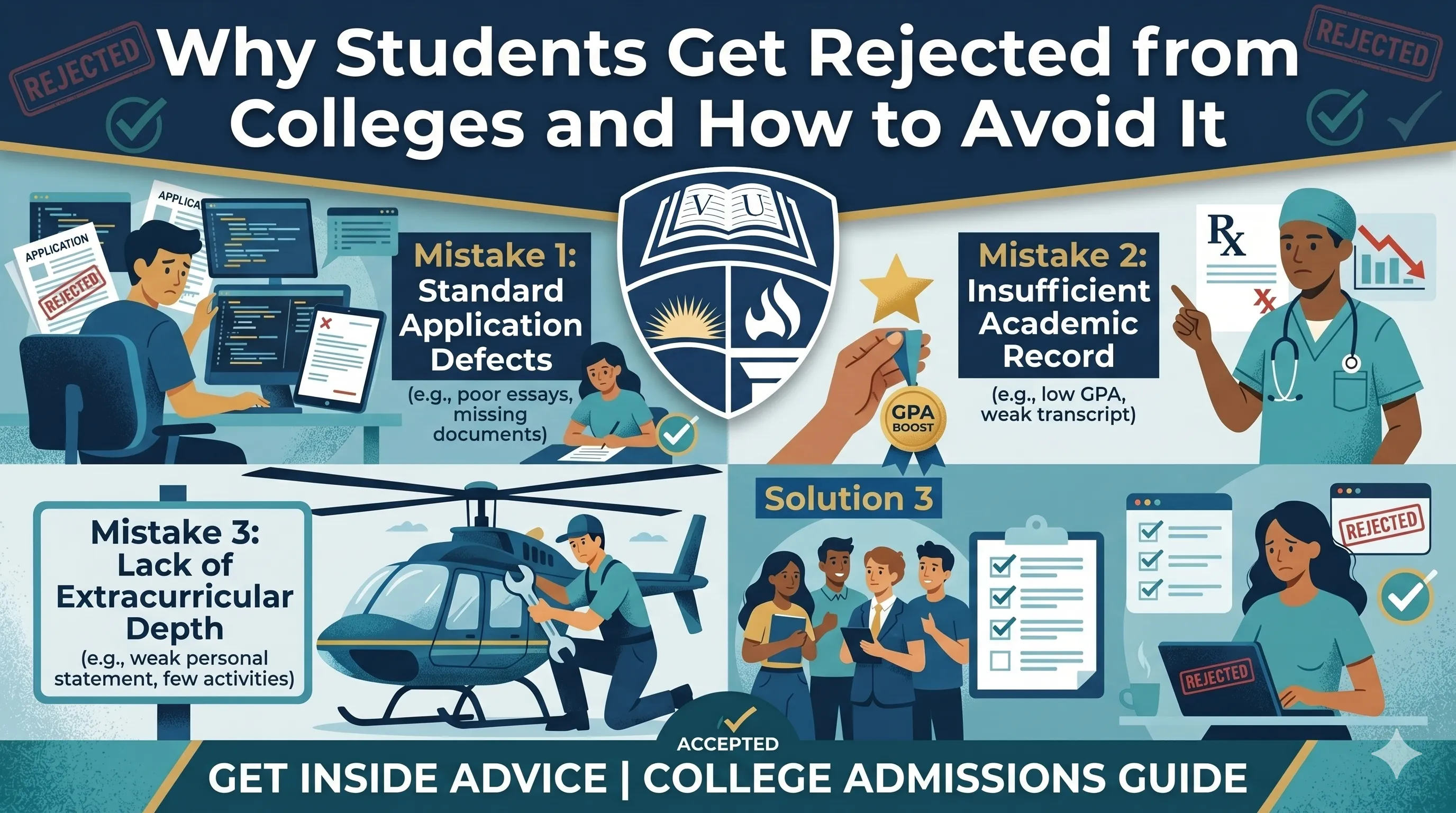
Every year, many Indian students face the same crushing moment. They open an email or check a website. And there it is: “We regret informing you…” The rejection letter. No explanation. No second chance. Just a polite no.
What makes it worse is that most of these rejections were completely avoidable. Students don’t get rejected because they are “not smart enough.” They get rejected because nobody taught them how to play the admission game correctly. Here is the raw truth about why college applications fail and exactly how to fix it.
The Hidden Reasons Behind College Rejection
1. Treating the Application Like a Formality
This is probably the most widespread mistake, and it costs thousands of students every single year.
Many students fill out their college application the same way they fill out a government form, quickly, without much thought, just trying to get through it. They enter their marks, attach their documents, and assume the college will figure out the rest.
But here's what they don't realise: admissions teams are looking for students who want to be there. Every section of an application is a signal. Your choice of programme, the way you describe your interests, even the accuracy of your documents, all of it communicates something. An incomplete or careless application communicates that you don't care enough.
Understanding the University Admission Process in India means understanding that this is a selection process, not just a paperwork exercise.
2. Ignoring Eligibility Criteria Until It's Too Late
You'd be surprised how many students discover they don't meet the minimum eligibility requirement after they've submitted their application.
Some programmes have specific subject requirements, a science background for engineering, mathematics as a compulsory subject for certain management courses, and so on. Some universities have minimum percentage cutoffs that vary by category. Students who assume they're eligible without checking the fine print often find themselves disqualified before their application is even reviewed.
The fix? Read the eligibility section first. Not last. Not after you've already fallen in love with the college.
3. Poor Research on the University
There's a certain kind of student who applies to a college because it appeared on a list somewhere, or because a friend mentioned it, or because the campus looked nice in photos. When they show up to a counselling session or an interview and can't articulate why they've chosen this institution, or what programme they're actually interested in, it reflects poorly.
This matters especially when you're comparing options. Understanding Private University Ranking India metrics, accreditation, faculty credentials, placement records, industry tie-ups, helps you make a case for your application, not just submit one. It also helps you decide whether a college is genuinely worth your time and money.
4. Submitting Incomplete or Incorrect Documents
This one is frustratingly common and also the easiest to fix.
Missing certificates, blurry scanned documents, incorrect name spellings, or gaps in submitted records, any of these can cause your application to be held up or rejected outright. Some universities have very tight windows for document submission. If your file is incomplete when the deadline hits, that's usually the end of it.
Create a checklist before you begin. Scan documents clearly. Double-check names, dates, and certificate validity. It sounds basic because it is basic, but basic mistakes have derailed countless admissions.
5. Not Accounting for Entrance Exam Performance
Many students apply to colleges based on their board exam marks while ignoring the entrance exam component entirely, or underestimating it. Several universities, including private ones, conduct their own entrance assessments or consider national-level scores alongside academic records.
If an institution you're interested in considers entrance performance as part of the University Admission in India process, that's not a side note. That's a central factor. Prepare for it accordingly.
What Actually Works: Doing the Admission Process Right
The University Admission Process in India is structured, but it rewards students who are proactive rather than reactive.
- Start early. Check the universities in which you want to get admission, not just their rankings, but their programmes, their faculty, their campus culture, and their placement statistics.
- When you compare Private University Ranking India data, look beyond the headline number.
- A university which is ranked 15th nationally with exceptional infrastructure and industry connections might serve you far better than one ranked 8th with none of that.
- Visit the official university website directly. Read the admission guidelines carefully. Confirm dates, eligibility, required documents, and the specific steps involved.
- If anything is unclear, contact the admissions office, they expect and welcome that kind of inquiry.
When you approach University Admission in India with this level of preparation, you're no longer hoping to get in. You're positioning yourself to get in.
The Bottom Line
Rejection is painful, but most of it is preventable. The students who get into their preferred colleges are not necessarily the smartest. They are the ones who understood the University Admission In India system, respected deadlines, paid attention to details, and built a smart list of universities.
Every year, thousands of seats remain empty while thousands of students remain rejected. That mismatch happens because of poor planning, not poor potential.
Ready to Secure Your Admission Without the Stress?
Do not leave your future to luck. Get the right guidance, check authentic Private University Ranking India, and understand every step of the University Admission Process India before you apply.
Visit Vikrant University Admission Portal. Your dream college is still within reach. Apply smart, not just hard.
Frequently Asked Questions
Q1.How does the general admission process take place in India for private universities?
Private universities in India have an admission process where there is an online form submission, verification of documents, then an examination/merit assessment, followed by counseling or interview.
Q2. How crucial is Private University Ranking India while opting for a college?
It will give you a good idea to start from, but do not rely on rankings alone; check for accreditation, quality of faculty, placement percentage, campus amenities, and program offerings.
Q3. Can a student reapply after rejection by a university in India?
In most cases, yes. Many universities permit students to reapply in the next academic year.
Q4. What documentation is usually needed when applying for admission to universities in India?
The standard documents include mark sheets for classes 10 and 12, a migration certificate, a character certificate, a passport-size photograph, an identity proof, and a caste category certificate (where applicable).
Q5. Is there any recommended time to prepare for university applications?
It is best if a student starts searching for his/her preferences six months prior to the opening date of the application form.